
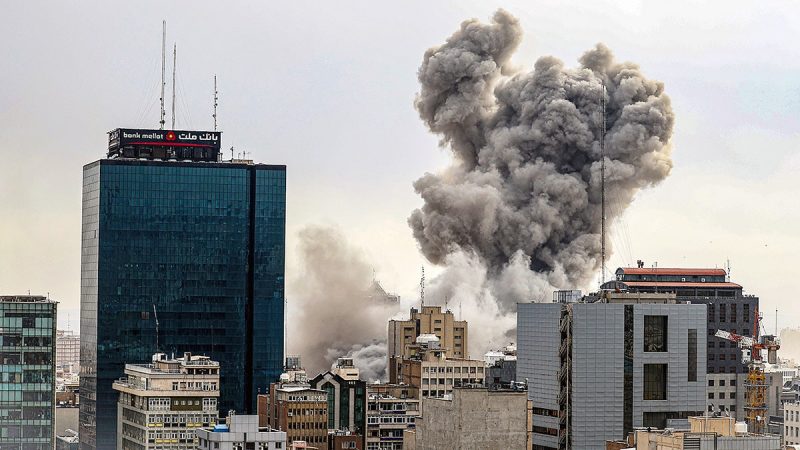
As U.S. and Israeli air forces continue to attack Iran’s leadership and facilities with devastating military strikes, there are intense discussions unfolding about who will rule the country if the regime falls.
One of the biggest questions being asked by Iran experts is whether the fragmented opposition groups can come together and unite in defeating the regime.
Lawdan Bazargan, anIranian political and human rights activist who was imprisoned by the regime for her dissident activities in the 1980s, told Fox News Digital there is a dangerous precedent for a total unified opposition.
Unity cannot mean everyone stands under my flag,’ she said.
‘That model failed Iran once before. In 1979, one figure [Ayatollah Ruhollah Khomeini] absorbed moral authority while claiming he wasn’t seeking office and ended up consolidating absolute power. It’s also not fair to automatically position someone who has not lived in Iran for decades as the interim authority of over 90 million people. That fuels more mistrust, not less.’
She also warned about the need to avoid a Venezuela situation in which Nicolás Maduro was replaced by his devotee, Delcy Rodríguez.
Mariam Memarsadeghi, a senior fellow at The Macdonald-Laurier Institute and founder and director of the Cyrus Forum for Iran’s Future, told Fox News Digital, ‘When it comes to helping unite opposition forces, the crown prince [Reza Pahlavi] has the most responsibility because he is leading. It is to everyone’s advantage for him to build true alliances and real cooperation.
‘He can start through reconciliation with prominent figures who once were in collaboration with him before spoilers in his own ranks were propelled by regime manipulation and infiltration to turn on others. It will be tempting to think that, because he is popular, he does not need others. But there is much hard work ahead.’
Reza Farnood, a researcher, writer and activist, told Fox News Digital, ‘In 48 years of activism and struggle, I have never experienced such broad unity and alignment. Even those who for years held firmly leftist views and were staunch opponents of the Shah and the Pahlavi family are now openly supporting the prince. Inside Iran, people are openly and courageously chanting his name.’
Yet others remain skeptical of Pahlavi.
‘Unfortunately, the Iranian opposition is more divided than ever,’ Alireza Nader, an Iran expert, said. ‘And I blame much of it on Reza Pahlavi and his team. Take the announcement of the formation of the new Kurdish Iranian coalition. Pahlavi attacked the coalition as soon as it was formed, labeling them as ‘separatists.’
‘But then Pahlavi had to walk back his statement after he found out that President Trump had called Kurdish leaders, an important development.’
Nader added, ‘The Kurds are very organized and capable. And they are armed. Anyone who wants to free Iran has to work with them. The regime is a deeply entrenched system in Iran. It’s an ideology and belief system that will not be uprooted with air strikes. And the regime has been preparing for this moment for decades. The individual leaders may not matter as much as the system.’
Yet while many voices claim Pahlavi should be the rightful successor to bring democracy to Iran, others point to the influential Mojahedin-e-Khalq (MEK), the Iranian exile organization that has attracted supporters like former Secretary of State Mike Pompeo and former New York City Mayor Rudy Giuliani.
The group was reportedly the first to highlight Iran’s nuclear weapons ambitions and regularly posts videos on its social media showing its active units operating against the regime. A post on X dated March 3 shows attacks against regime targets.
‘Resistance Units step up anti-regime activities nationwide,’ it said, adding that there have been 30 operations in 15 cities, including Tehran, in recent days.
Its Paris-based leader, Maryam Rajavi, says she supports a secular provisional government. Ali Safavi, an official with the Foreign Affairs Committee of the Paris-based National Council of Resistance of Iran (NCRI), told Fox News Digital, the organization ‘has consistently argued that unity must be built on principles — republicanism, popular sovereignty, human rights and the separation of religion and state — rather than on personalities or nostalgia for past systems.’
The NCRI is the umbrella organization for groups that fall under MEK.
Andrew Ghalili, the policy director for the National Union for Democracy in Iran (NUFDI), defended Pahlavi’s standing, saying, ‘There is no figure within the Islamic Republic who has legitimacy with the Iranian people or who would be a credible partner for the U.S.
‘As for opposition unity, the pro-democracy opposition is more united than it gets credit for. At the Munich Security Conference in 2025, a broad coalition came together around Crown Prince Reza Pahlavi and four core principles for democratic transition. That includes monarchists, republicans, human rights advocates, ethnic minority representatives — all committed to a democratic, territorially intact Iran.’
Ghalili claimed, ‘When people say the opposition is ‘fractured,’ they’re usually lumping in groups like the MEK, which is universally reviled inside Iran and has no democratic credentials or aspirations, or separatist movements that don’t reflect what Iranians, including ethnic minorities, actually want. The real pro-democracy opposition is already uniting. The world, and international media, should recognize it.’
‘If the West truly wants stability and not a Venezuela-style managed authoritarian transition, it should not anoint personalities,’ Bazargan warned. ‘It should push for a structured transition that guarantees free and fair elections within 12 months, with distributed authority and real safeguards against concentration of power.
‘Iran does not need another supreme figure, even a secular one. It needs an accountable transitional framework, so every Iranian feels they have a stake in their future. Without that, fragmentation will continue, and fragmentation only helps the regime survive.’
Her warning was echoed by Memarsadeghi, who said, ‘The Iranian people will not trust in any process that leaves in power any vestige of the regime that massacred them.’